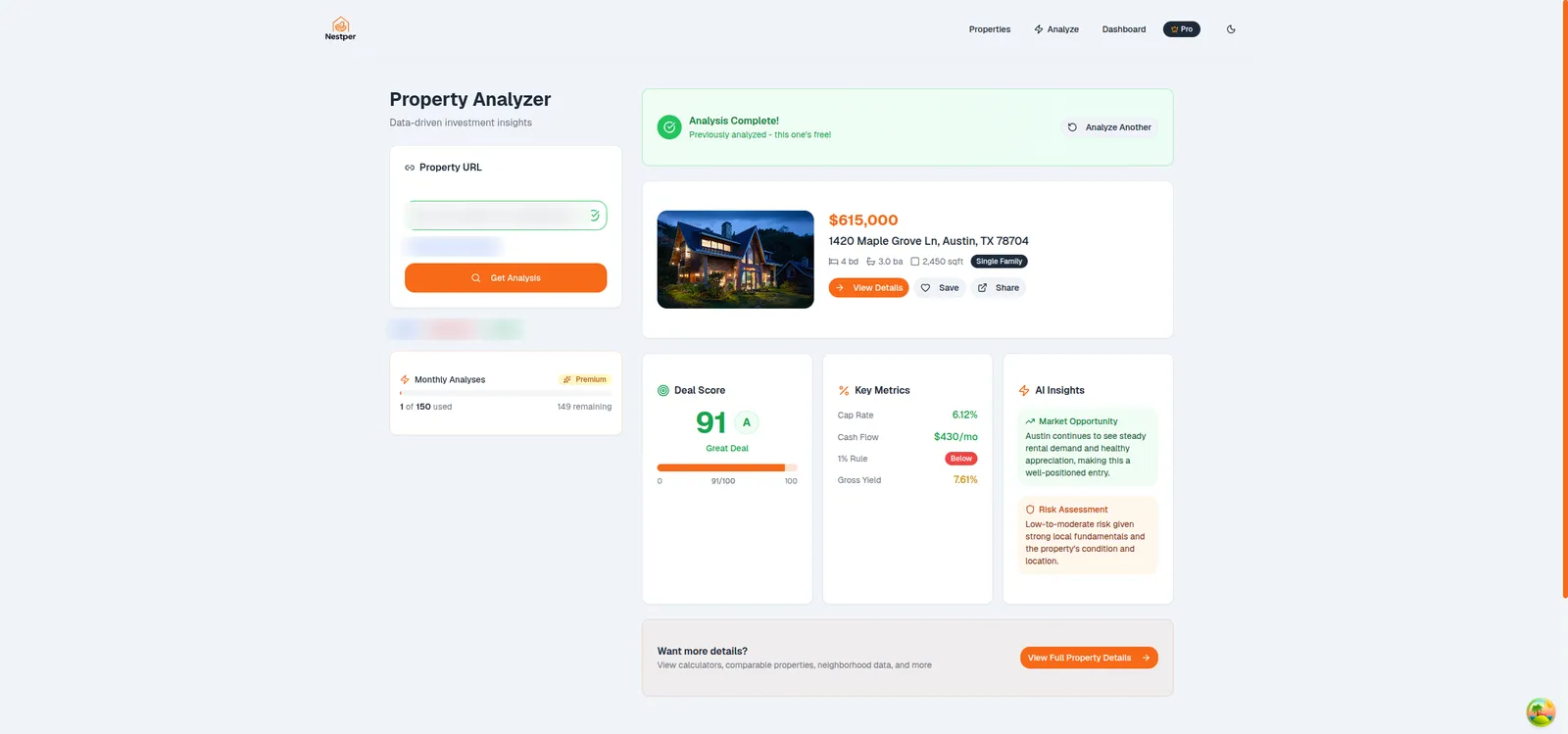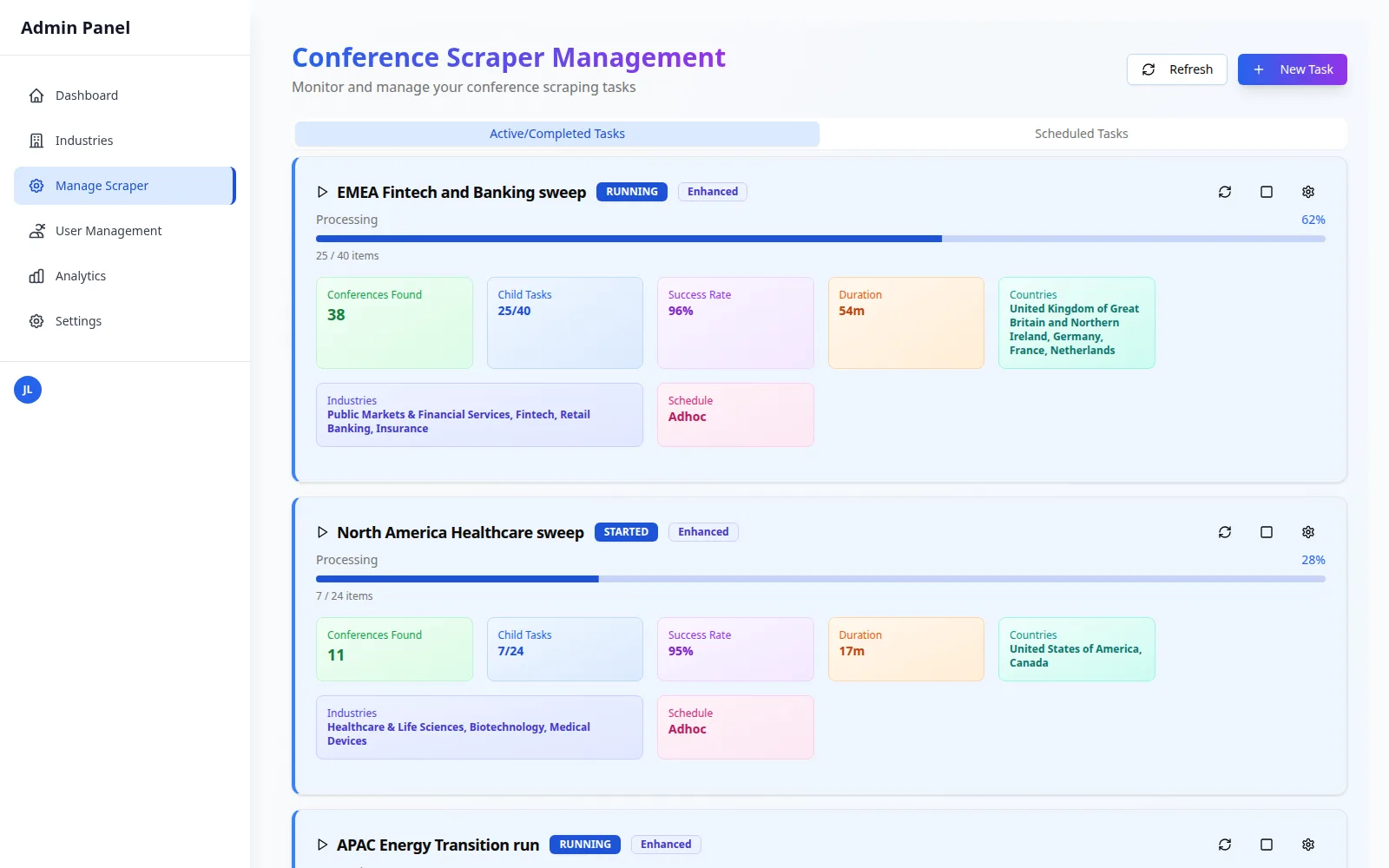
A startup that has just raised money is hiring, buying tools and choosing vendors. That makes funding news a good reason to get in touch. The trouble is that the news is scattered across filings, press releases and headlines, and no two are written the same way.
This guide is for founders who want to track newly funded startups and end up with a startup funding lead list they can sort and trust. It draws on a pipeline built for Pesql, described in the startup intelligence case study. The sample headlines and figures below are made up; the rules are the ones that mattered in that build.
The whole job is four steps:
| Step | What happens | Who decides |
|---|---|---|
| 1. Collect | Pull new filings and press releases from each source | Code |
| 2. Filter and extract | Keep funding headlines, then read out the company name and amount | Code, with rejection rules |
| 3. Score | Rate each startup on a few judgment questions | AI, checked by code |
| 4. Store | Save the record with its source, ready to sort and filter | Code |
Illustrative diagram. Collect → Filter and extract → Score → Store.
Where does startup funding news come from?
From three kinds of places: regulator filings, press-release wires and news headlines. Use more than one, because each one misses things the others catch.
The most useful filing for US startups is SEC Form D. A company files it when it raises money privately, and it states the size of the offering. It is official, which makes it a good anchor. It also has two pitfalls:
- Many filings are not startups. Funds and special purpose vehicles (SPVs, single-purpose entities set up to hold an investment) file Form D too. Filter them out, or your list fills with investment vehicles.
- The industry field is coarse. It is a broad category, so treat it as a hint and not as the answer to "is this a software company?".
The second source is the press-release wires, such as PR Newswire and BusinessWire, which publish RSS feeds. Companies announce rounds there in their own words. The cost is messy text: every headline is phrased differently.
A custom pipeline earns its place when you want your own filters and your own scoring.
The Pesql pipeline had scrapers for Form D listings, which kept only the rows marked as a new filing with a non-zero amount and followed the pagination, and for the PR Newswire and BusinessWire feeds. Before reading anything closely, it ran a keyword check on each headline: raises, raised, funding, investment, series, secured, financing, seed round, venture, capital. A headline with none of those is dropped. That is the cheapest filter you can build, and it clears out obvious noise before any harder work starts.
How do you pull company names and amounts out of messy text?
Write patterns for the common phrasings first, fall back to a language library for the rest, and reject any result that looks wrong. Rules are cheap, repeatable and easy to explain, so they do the bulk of the work.
Company names. Most funding headlines follow a few shapes: "X raises…", "X closes a Series A…". A pattern for each shape catches many headlines. For the headlines no pattern fits, the pipeline used spaCy, a free open-source library whose named-entity recognition tags names of organizations in text, as a fallback. Then it cleaned up and rejected:
- Legal suffixes such as Inc or LLC are stripped, so the same company is not stored under two spellings.
- Names that look like investors, such as those containing ventures or capital partners, are rejected. In "an investor leads a round in a startup", the investor is often named first.
- Names longer than 4 words or longer than 40 characters are rejected. A long "name" is usually a sentence fragment.
Amounts. Amounts are also read with patterns, then checked against the text around them. The pipeline dropped an amount when that text mentioned assets under management, portfolio value, market size, revenue or valuation, because the number was then about something else. Implausibly large values were rejected, and euros were converted at a fixed rate. A fixed rate is fine for ranking a list; it is not accounting.
Here is how those rules treat a few made-up headlines:
| Example headline | What the rules do |
|---|---|
| Northwind Labs, Inc. raises $4.5M Series A | Keeps "Northwind Labs" (suffix stripped) and $4.5M |
| Harbor Capital Partners closes new fund | Rejects the name: it looks like an investor |
| Larkspur Health secures seed round, targets a $40B market | Keeps the name, drops the amount: the text is about market size |
| Birchwood Data raises EUR 3M | Keeps the name, converts the amount at a fixed rate |
Example figures for illustration.
Notice that a rejected record is better than a wrong one. A lead list with a blank amount is still useful. A list with a $40 billion "funding round" teaches everyone to stop trusting it.
How do you avoid duplicates and wrong numbers?
Give every item a key and skip anything you have already processed, then treat every extracted value as suspect until a rule has looked at it. Duplicates and wrong numbers are what make a lead list feel unreliable, and both are easy to prevent if you plan for them.
Feeds repeat themselves. The same release shows up on every fetch, and a filing can be listed again. In the Pesql pipeline an item already processed was skipped, using a key of company name plus date for each source. That one rule stops the same record being scored and stored twice, which also saves money on the scoring step. If you use several sources, decide how you will merge the same raise reported twice. A key for each source does not do that on its own.
Wrong numbers come from the rules in the previous section: the context check on amounts, the plausibility limit, the name rejections. Add one more place where a wrong match does damage, which is enrichment. The pipeline also looked up headcount and growth in LinkedIn Sales Navigator. It matched a company by name similarity and by website domain, and it was rate-limited to a small number of companies per day. Matching on two signals is the point. A similar name alone would sometimes attach another company's headcount to your record.
- Keep the source with every record. A link back to the headline or filing lets anyone check a number in seconds.
- Prefer a blank to a guess. Missing is honest; wrong looks real.
- Respect the limits of the tools you call. A daily cap on lookups is part of the design, not a bug to work around.
What should AI score, and how do you trust it?
AI should score only what rules cannot judge, and its answer should be checked by code before you store it. Size of offering, recency and whether a contact exists can all be worked out with plain rules, so keep them in code. How innovative a company looks, or how unique its idea is, is a judgment call. That is what the model is for.
In the Pesql pipeline, GPT scored each startup on innovation, market potential and uniqueness, each from 1 to 10. There were two ways to call it. One path scored a single startup per call. The other was a batch path that sent ten startups per call to keep cost down; cutting AI running costs explains why fewer, fuller calls cost less.
The replies were parsed by code rather than read by a person. On the one-by-one path, a reply whose scores could not be parsed, or fell outside 0 to 10, was rejected and not stored. Whichever way you call the model, apply the same discipline:
- Ask for a fixed shape. Three numbers in a known format are easy to check. Free-form prose is not.
- Validate every reply. Can it be parsed? Is each score inside the range you asked for? If not, reject it.
- Store nothing you cannot read. A missing score is better than an invented one, and you can score the company again later.
- Read the scores as opinions. They help you sort a long list. They are not facts about the company.
This is the same pattern as in any AI feature: rules first, AI for the judgment, and a check on what comes back. The AI automation service page covers how it is built into real products.
Where should the data live?
Wherever your team can read, sort and filter it today, with a key that survives a move. The first version rarely needs more than a table people already know how to use.
The Pesql records went to Airtable, written in batches rather than one at a time. Later the data moved to Supabase, which is built on PostgreSQL, with a React front end built on top. That is a common path: start in a spreadsheet-style tool so the team can use the list at once, and move to a database when you need more users, richer search or a history of changes.
Two habits make the move painless:
- Store the raw headline and its link next to the extracted fields. You can then re-run improved rules over old records instead of starting again.
- Use a stable key for every company. The same key that stops duplicates also lets you carry records from one system to the next without losing track of them.
If you want to scope a pipeline like this, a Build Plan is the place to start: from $500, ready in 2 to 3 days, credited in full toward the build, and yours to keep either way. See how it was done in the startup intelligence case study, or start with a free 30-minute call.
Questions founders ask
Combine regulator filings, such as SEC Form D in the US, with press-release wires like PR Newswire and BusinessWire. Filings are official and state the offering size. Wires carry the announcement in the company's own words. Using both catches rounds that either one alone would miss.
Funds and special purpose vehicles file Form D too, so a raw list includes investment vehicles that are not startups. The industry field is also a broad category. Filter out funds and SPVs, and treat the industry field as a hint rather than an answer.
Give every item a key, such as company name plus date for each source, and skip anything already processed. Strip legal suffixes like Inc and LLC so one company is not stored under two spellings. If you use several sources, decide how to merge the same raise reported twice.
No. Use plain rules for what code can decide: keyword filters, name and amount extraction, and rejection of values that look wrong. Use AI for judgment calls, such as how innovative a company looks, and validate every reply in code before storing it.
It depends on your sources and scoring. A Build Plan, from $500 and ready in 2 to 3 days, writes down the sources, rules and scoring and gives a fixed quote before any code is written. The fee is credited in full toward the build.

Technical partner for real-estate and fintech founders: decides with you what to build, launches it and stays on after launch. Top Rated Plus on Upwork with 100% Job Success. Builds MVPs, rescues stalled builds and hardens AI prototypes.
See client work →